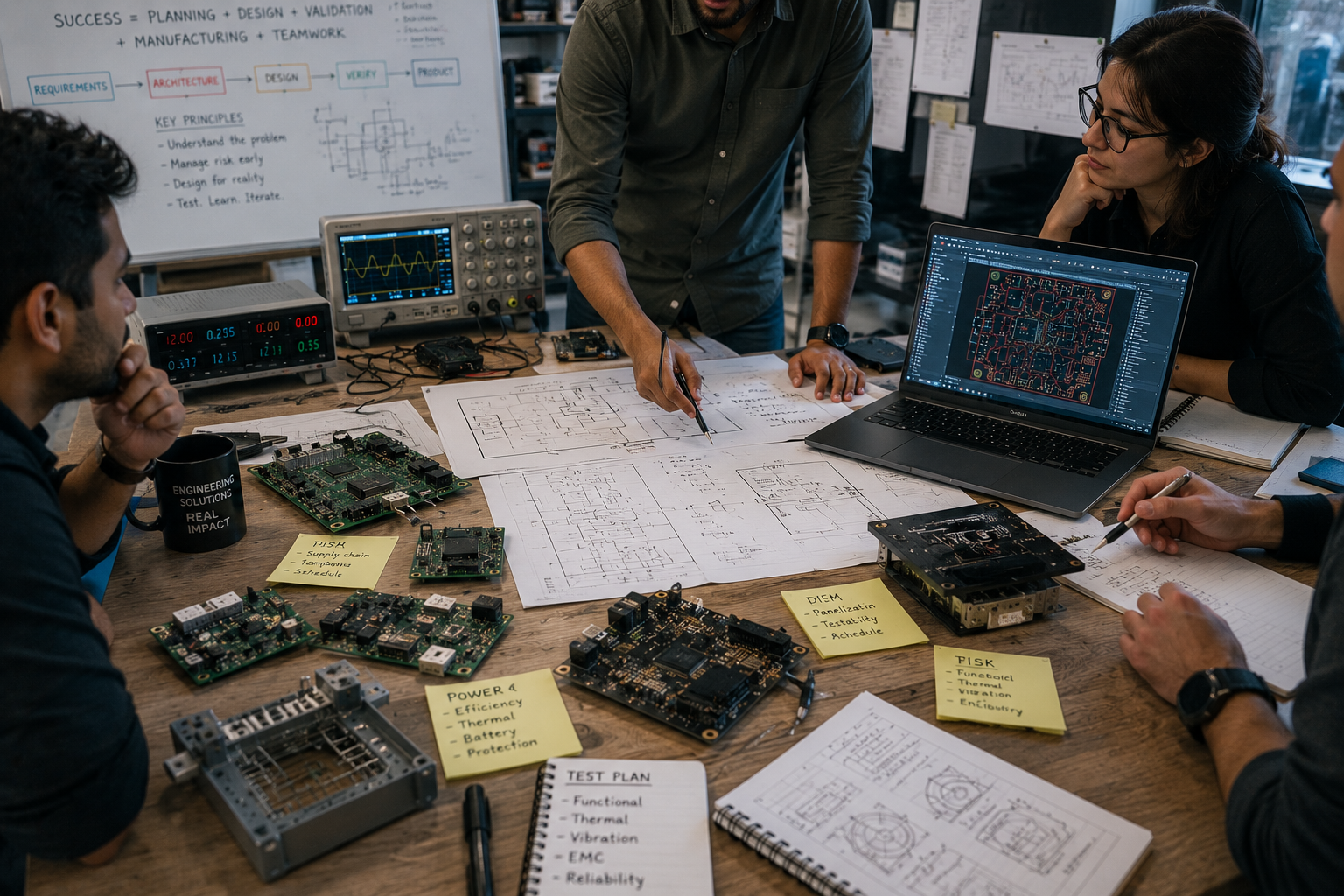
ENGINEERING INSIGHTS
The Foundations of Successful Hardware Development
Understanding the engineering principles that separate deployable products from expensive prototypes.
Understanding the engineering principles that separate deployable products from expensive prototypes.
Successful hardware products rarely happen by accident.
While breakthrough ideas often receive the most attention, the long-term success of a product is usually determined by the engineering decisions made throughout development.
Some products move smoothly from concept to deployment. Others encounter repeated redesigns, manufacturing challenges, certification issues, cost overruns, or reliability problems.
The difference is rarely intelligence or effort.
More often, it comes down to engineering process, risk management, and decision-making discipline.
Over time, certain patterns consistently appear in successful development programs regardless of industry, product category, or team size.
One of the most common misconceptions in product development is that success begins with schematic design, firmware development, or PCB layout.
In reality, successful projects often begin much earlier.
Before any technical work starts, teams must understand:
When these questions remain unanswered, engineering teams are forced to make assumptions.
Assumptions eventually become redesigns.
Requirements are often viewed as documentation.
In reality, they are decision-making tools.
Good requirements reduce ambiguity and provide a framework for evaluating design choices throughout development.
Effective requirements typically define:
The clearer the requirements become, the easier it becomes to make consistent engineering decisions.
Many successful projects begin with a formal requirements process. Learn more in: How to Write an Electronics Development Requirement (EDR)
Product architecture determines how well a system can adapt to future challenges.
Processor selection, communication protocols, power systems, software structure, and mechanical integration all influence future development flexibility.
Many products perform adequately during prototyping but become difficult to maintain because architectural decisions were optimized only for short-term objectives.
Good architecture balances:
There is rarely a perfect solution.
Successful engineering teams focus on finding the right balance rather than maximizing a single parameter.
Every engineering project contains uncertainty.
New technologies, unfamiliar operating conditions, supply chain concerns, and integration challenges all introduce risk.
Successful teams actively identify these risks before they become development problems.
Rather than assuming everything will work as expected, they continuously validate assumptions through analysis, prototyping, simulation, and testing.
A wireless device intended for industrial deployment may technically function in the laboratory while experiencing communication issues in real operating environments.
Identifying this risk during early testing can prevent significant redesign effort later.
Managing uncertainty is one reason development timelines often extend beyond initial expectations. Related: Why Hardware Development Feels Slow
One of the most common reasons hardware projects struggle during commercialization is that manufacturing considerations were introduced too late in the development cycle.
A prototype only needs to function.
A manufactured product must be assembled consistently, tested efficiently, sourced reliably, and produced economically.
Design for Manufacturing, often referred to as DFM, helps bridge the gap between engineering success and production success.
Important manufacturing considerations include:
Products that incorporate manufacturing requirements early tend to move into production with fewer surprises and lower overall costs.
Many prototypes can successfully demonstrate functionality.
Verification goes significantly further.
Verification seeks to answer a different question:
Verification activities may include:
Discovering issues during verification is significantly less expensive than discovering them after deployment.
Successful teams invest heavily in learning where products fail before customers do.
Documentation is often viewed as a secondary activity.
In reality, it serves as the memory of the development program.
Without proper documentation, critical engineering decisions can become difficult to understand, maintain, or reproduce in the future.
Useful documentation typically includes:
As products mature and teams grow, documentation becomes increasingly valuable.
It reduces dependency on individual contributors and improves long-term maintainability.
Successful hardware development is ultimately a human activity.
Tools, software, and processes are important, but engineering outcomes are heavily influenced by communication, collaboration, and decision-making.
Teams that openly discuss risks, challenge assumptions, and share information tend to make better technical decisions.
Conversely, many development problems can be traced back to communication failures rather than technical limitations.
Engineering excellence depends as much on teamwork as it does on technical expertise.
Few successful products emerge fully optimized from their first prototype.
Development is normally an iterative process.
Teams learn from prototypes, testing, customer feedback, manufacturing trials, and field deployments.
Each iteration improves understanding and reduces uncertainty.
The most successful organizations do not attempt to eliminate iteration.
They create processes that make iteration efficient and informative.
There is no single technology, tool, or methodology that guarantees successful hardware development.
Successful products emerge when clear requirements, thoughtful architecture, disciplined risk management, thorough testing, manufacturing awareness, and effective collaboration work together.
The strongest engineering teams are not necessarily those with the most resources.
They are the teams that consistently make informed decisions and learn quickly from new information.
Many successful products begin as DIY prototypes before evolving into professionally engineered systems. Read: DIY Hardware Development
Successful hardware products emerge from disciplined engineering processes that balance requirements, risk management, verification, manufacturing readiness, and continuous learning.
Whether you're planning a new product, preparing for manufacturing, or navigating complex technical challenges, our engineering team can help identify risks and build a practical path toward deployment.
Discuss Your Project