PRODUCT DEVELOPMENT
Why Hardware Development Feels Slow
Understanding why successful electronics products take time and why delays are often part of the engineering process.
Understanding why successful electronics products take time and why delays are often part of the engineering process.
Nearly every hardware founder experiences the same moment.
The idea seemed straightforward.
The prototype looked achievable.
The initial timeline felt reasonable.
Then reality arrived.
Components needed replacement. Firmware became more complicated. Testing uncovered unexpected issues. Manufacturing constraints appeared. Compliance requirements emerged.
Suddenly, a project that looked like a three-month effort feels like it may take a year.
This experience is so common that many founders assume something has gone wrong.
Often, nothing is wrong.
They are simply experiencing the reality of hardware development.
Projects with clearly defined requirements generally experience fewer surprises. You may find this guide useful: How to Write an Electronics Development Requirement (EDR)
Many modern businesses are influenced by software development culture.
Software can often be modified, deployed, tested, and updated within hours.
Hardware operates under different constraints.
Every design decision eventually becomes a physical object.
Components must be sourced. Boards must be manufactured. Assemblies must be tested. Mechanical parts must fit.
Physical reality introduces delays that software teams rarely encounter.
It is slower because physical systems require validation in the real world.
Many development plans assume the first prototype will answer all major technical questions.
In reality, prototypes often generate new questions.
A sensor may behave differently than expected.
Battery life may not meet projections.
Thermal behaviour may require redesign.
Wireless performance may vary across environments.
These discoveries are not failures.
They are exactly why prototypes exist.
Many developers first encounter these challenges while building their own prototypes. Related: DIY Hardware Development
Product development is frequently viewed as a process of building things.
In reality, much of engineering is about reducing uncertainty.
Every test, review, simulation, and prototype exists to answer questions.
The more ambitious the product becomes, the more questions must be answered.
This is one of the primary reasons complex projects take longer than originally expected.
Many of these delays are closely related to engineering process and risk management. Further reading: The Foundations of Successful Hardware Development
One of the most frustrating moments in hardware development occurs when a design that appears complete suddenly requires modification.
To many founders, this feels like lost progress.
To experienced engineers, it is often a normal part of development.
The purpose of testing is not to confirm that everything is perfect.
The purpose of testing is to discover what still needs improvement.
Every redesign removes uncertainty and improves the product's chances of succeeding in the real world.
A product may function correctly in a laboratory environment but fail when exposed to temperature extremes, vibration, electrical noise, or inconsistent user behaviour.
Discovering these issues before deployment is far less expensive than discovering them after customers begin using the product.
Many teams underestimate how different manufacturing is from prototyping.
Building one working device and building hundreds or thousands of devices are fundamentally different challenges.
Manufacturing introduces considerations such as:
Even when the engineering is complete, manufacturing preparation can require significant time and effort.
Products intended for commercial deployment frequently require regulatory approvals and certifications.
Depending on the application and market, this may include BIS, CE, FCC, safety certifications, or industry-specific requirements.
Certification testing is not simply paperwork.
It often validates design decisions made months earlier.
When compliance requirements are considered late in development, redesigns become much more likely.
This is one reason experienced teams try to identify certification requirements early.
Many people assume delays occur only because a team lacks experience.
Experience certainly helps, but even highly capable engineering teams encounter unexpected challenges.
New technologies introduce uncertainty.
Suppliers change specifications.
Components become unavailable.
Customer requirements evolve.
Real-world testing reveals previously unknown behaviours.
Good engineering does not eliminate surprises.
Good engineering helps teams respond to surprises effectively.
They are the projects that identify problems early enough to solve them before deployment.
While many delays are normal, some delays indicate deeper issues.
Warning signs may include:
These situations can create delays that are avoidable and should be addressed as early as possible.
One reason hardware development feels slow is that much of the work is not immediately visible.
Requirements reviews, architecture studies, simulations, testing, debugging, supplier evaluations, compliance planning, and manufacturing preparation may not produce dramatic visual results.
Yet these activities often determine whether a product ultimately succeeds.
Some of the most valuable engineering work happens long before a new prototype appears on a workbench.
Hardware development is a process of learning, validation, and risk reduction.
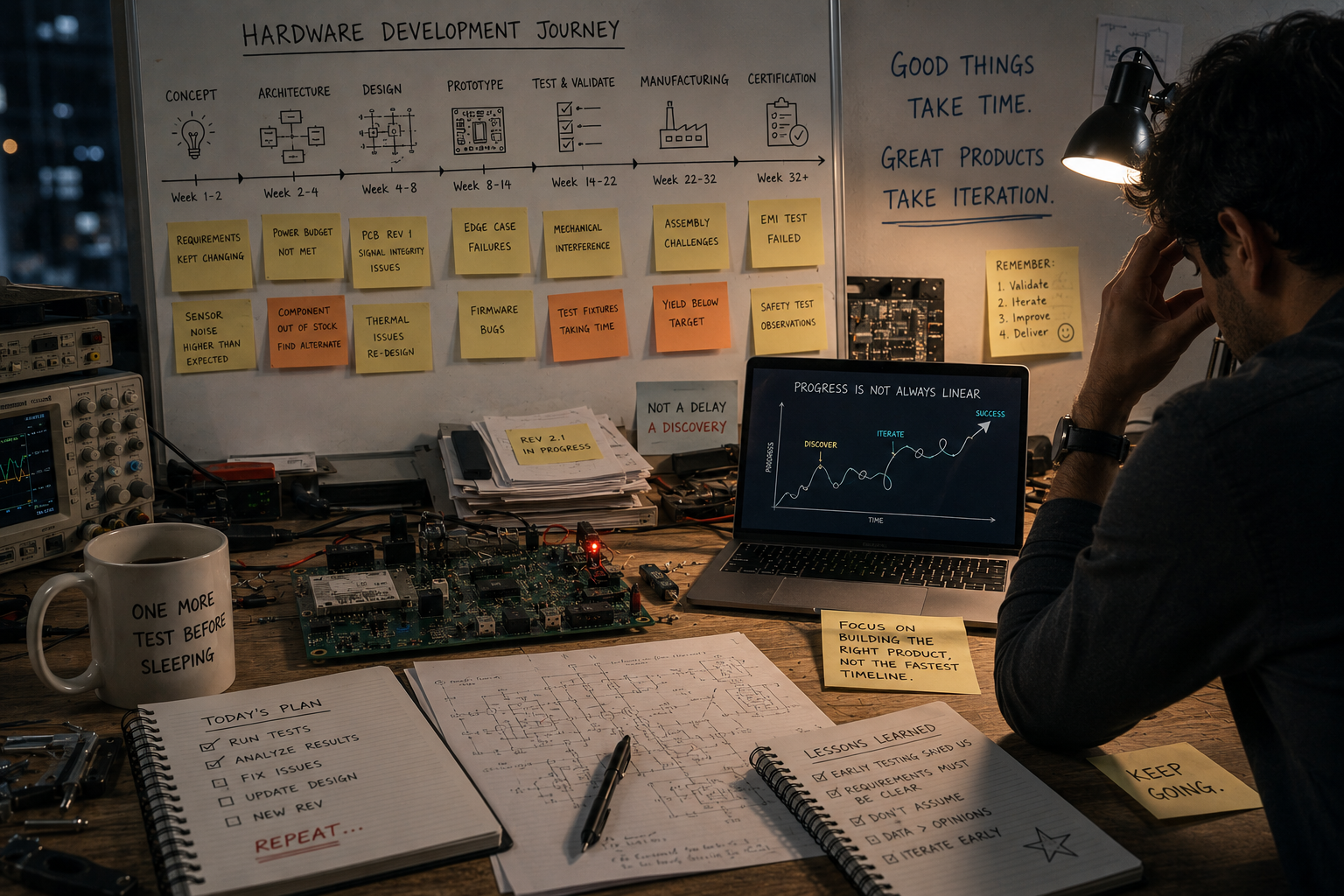
Progress is rarely linear.
Prototypes reveal new information. Testing uncovers weaknesses. Manufacturing introduces constraints. Certification validates assumptions.
These activities take time because they create confidence that the product will perform reliably when deployed.
While unnecessary delays should always be addressed, many of the challenges encountered during development are simply part of building successful products.
Hardware development is rarely a straight line. The most successful projects focus on reducing uncertainty, validating assumptions, and making informed engineering decisions throughout development.
Whether you're facing technical uncertainty, manufacturing challenges, certification requirements, or repeated redesigns, our engineering team can help identify risks and create a practical path forward.
Discuss Your Project